
Building partnerships that enhance our economic and cultural future through the preservation of Iowa's historic resources.
The future of Iowa is sustainable communities with an authentic sense of place created by their important historic structures. The rehabilitation and reuse of our historic buildings is both economically attractive and environmentally responsible; it is important to citizens and visitors to our state as well as for future generations.
Iowa Programs
Iowa’s Most Endangered Properties
Iowa’s Most Endangered Properties began in 1995 to show Iowans the special buildings and historic sites that are slowly and gradually slipping away from us. The program provides an excellent resource for media coverage and introduces endangered property owners to preservation advocates and resources that can help preserve their historic property.
Preservation at Its Best Awards
Each year Preservation Iowa seeks to honor statewide successes through the “Preservation at its Best Awards”. In doing so, we hope to inspire others to take action to preserve, protect, and promote Iowa’s historic resources. Additionally these projects highlight the work being done around the state to preserve our historic infrastructures by re-purposing them to allow reintegration into their local communities.
Property Types
Preservation Iowa focuses on providing information, raising awareness and protecting property types that hold special significance for Iowans.
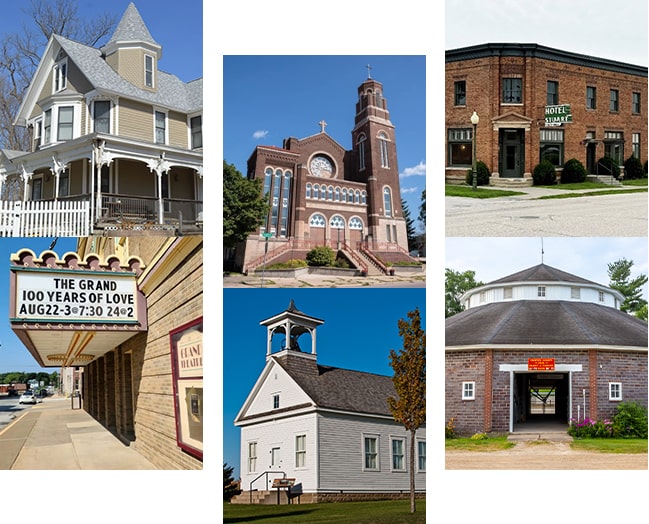
Its efforts encompass a wide range of historic resources, including residential buildings, commercial and industrial structures, sacred places, schools, and movie theaters, as well as rural properties such as farmsteads and barns.
Residential
Movie Theaters
Sacred Places
Commercial & Industrial
Schools
Farmsteads & Barns
Check out Section 106 in the News for information on Section 106 of the National Historic Preservation Act and why it is currently a hot topic of discussion.
Preservation News from across the State and Nation
This week we celebrate the Iowa City Municipal Airport Terminal in Iowa City, Iowa which was recently listed on the National Register of Historic Places. This building, constructed in 1953, expresses the glamour and excitement of passenger air travel in the era following World War II. Designed by Iowa City architect Henry Leach Fisk, the building’s construction was funded by city airport bonds and a grant from the federal Civil Aeronautics Administration. Essentially unaltered, the airport terminal embodies the distinctive characteristics of the International style including an asymmetrical composition of rectilinear geometric forms, a flat roof without coping, horizontal bands of windows, and flat wall surfaces without decoration. Large windows on the runway elevation allowed optimal viewing of the planes from both the first and second floors. Additionally, the interior plan remains intact as does the staircase with its aluminum and glass railing to the second floor (location of the Cloud Room restaurant), light fixtures, and an original phone booth. Congratulations Iowa City! #iowaarchitecture #iowaaviation #IowaHistory #friendsofhistoricpreservation


You'll want to listen to this episode of Talk of Iowa with guests John Doershuk, state archaeologist and director, Office of the State Archaeologist; Elizabeth Reetz, strategic initiatives director, Office of the State Archaeologist; Tieranny Keahna, tribal historic preservation officer, Sac & Fox Tribe of the Mississippi in Iowa; and Shawn Patch, president, American Cultural Resources Association

Members of the Radcliffe Fire Department are attempting to raise roughly $25,000 to help fund preservation efforts on the historical location that housed the fire department beginning in 1897. The department has plans for a museum. Read more about the old fire department by clicking the link below. https://www.timescitizen.com/news/radcliffe-firefighters-fundraising-to-preserve-old-fire-station/article_0cd3c02c-1ecc-4b41-9efd-b48a5d7b79c0.html

The National Historic Preservation Act celebrates 60 years today. Watch this five minute video that explains why six decades later this legislation is critical to preserving our nation's history. Please share to your own networks.
A large bill will be considered by the Senate right after the election that will adversely affect historic resources and public participation in federal projects at the local level. Read more here: https://savingplaces.org/press-center/media-resources/national-trust-rejects-key-provisions-of-permitting-reform-bill The National Trust for Historic Preservation has linked a letter here that you can send to Senators Grassley and Ernst: https://support.savingplaces.org/page/103529/action/1?ea.tracking.id=Email&ea.url.id=6157771&forwarded=true Or you can send a comment using these links: Senator Charles Grassley https://www.grassley.senate.gov/constituents/questions-and-comments Senator Joni Ernst https://www.ernst.senate.gov/public/index.cfm/contact
