
Building partnerships that enhance our economic and cultural future through the preservation of Iowa's historic resources.
The future of Iowa is sustainable communities with an authentic sense of place created by their important historic structures. The rehabilitation and reuse of our historic buildings is both economically attractive and environmentally responsible; it is important to citizens and visitors to our state as well as for future generations.
Iowa Programs
Iowa’s Most Endangered Properties
Iowa’s Most Endangered Properties began in 1995 to show Iowans the special buildings and historic sites that are slowly and gradually slipping away from us. The program provides an excellent resource for media coverage and introduces endangered property owners to preservation advocates and resources that can help preserve their historic property.
Preservation at Its Best Awards
Each year Preservation Iowa seeks to honor statewide successes through the “Preservation at its Best Awards”. In doing so, we hope to inspire others to take action to preserve, protect, and promote Iowa’s historic resources. Additionally these projects highlight the work being done around the state to preserve our historic infrastructures by re-purposing them to allow reintegration into their local communities.
Property Types
Preservation Iowa focuses on providing information, raising awareness and protecting property types that hold special significance for Iowans.
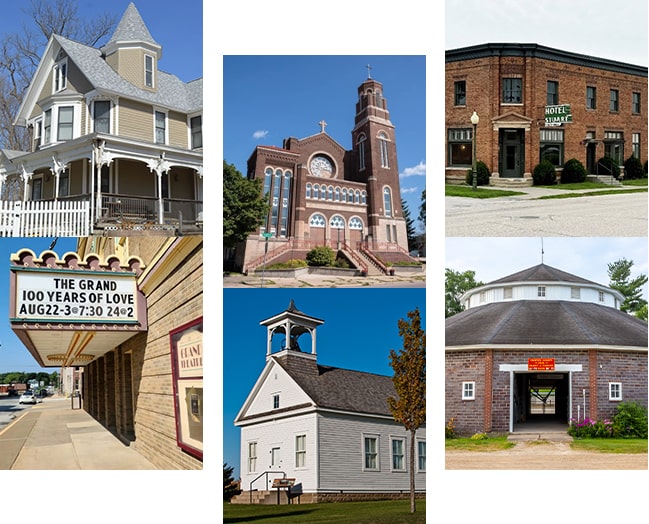
Its efforts encompass a wide range of historic resources, including residential buildings, commercial and industrial structures, sacred places, schools, and movie theaters, as well as rural properties such as farmsteads and barns.
Residential
Movie Theaters
Sacred Places
Commercial & Industrial
Schools
Farmsteads & Barns
Preservation News From Across The State
3rd Property To Be Announced 2026 MOST ENDANGERED PROPERTY White Springs Supper Club, McGregor, Clayton County The White Springs Ballroom opened in 1936 on Hwy. 18 just west of McGregor. It was the idea of Archie Fritz who wanted to capitalize on interest in the white sand caves located in the cliff in the back of the property. The hand-hewn caves were originally built to provide cold beer storage for the West McGregor Brewery that began operation on the site in 1857 and operated until the late 1800s. As early as 1933, Fritz started work to make the caves accessible to visitors including hanging electric lights in the caves. The two-story building Fritz constructed on the foundations of the old brewery originally had a ballroom on the second floor and a tavern on the first floor. In the 1940s, ads in newspapers across northeast Iowa advertised the visiting bands for weekly Saturday night dances. Erwin and Ethel Mann purchased the business in 1949. By the mid-1960s, the focus was more as a dining establishment rather than a dance hall and had been renamed the White Springs Supper Club. An article in the July 26, 1967 Arlington Progressive noted that Mrs. Mann was famous for her Hickory Smoked Barbeque Ribs. For decades, the White Springs Supper Club was a dining destination and a social gathering place for northeast Iowa. After Ethel Mann’s death in 2004, there were a few attempts to continue the legacy of the supper club but today it remains closed and empty. In addition to the Supper Club building, the site currently includes the original sand caves, the brick house of former brewer Michael Klein (c. 1895) and a stone garage that was formerly a stable. Since the closure of the supper club, the buildings on the property have fallen into disrepair and are in danger of being demolished. A portion of the roof of the former stable has already collapsed. The future of the property remains uncertain.


2nd Property To Be Announced 2026 MOST ENDANGERED PROPERTY Meyers Farmstead District within Pleasant Grove Heritage Park, Lisbon, Linn County Jacob Meyers, the son of one of Lisbon’s earliest settlers, bought this farmstead which sits on the town’s outskirts in 1881. His son, John, eventually took over the farming operations until retiring in 1940. The Meyers family raised hogs, cattle, and dairy cows as well as crops. After 1940, the Meyers family retained ownership but rented the farmstead and it continued to be operated as a farm. They sold the farmstead in the early 1980s with the new owners also utilizing it for agricultural purposes. The City of Lisbon purchased the property in 2018 with the intention of developing the farmstead into a park. Pleasant Grove Heritage Park Inc. purchased the farmstead from the city in order to continue to pursue the creation of an agricultural park and historic district. The farmstead was placed on the National Register of Historic Places in 2021. Several agricultural structures remain on the farmstead dominated by the gabled or "banked" barn (c.1872) which originally housed hay, machinery, and livestock. The Pennsylvania type barn illustrates the “Pennsylvania Dutch” and German heritage of the early settlers of Lisbon. In the early 1900s, the basement was remodeled to include a modern dairy the equipment of which remains. At that time, the silo next to the barn was also added. The dairy operated until the late 1960s. The site also boasts an uncommon combination corn crib(above) and hog house(underneath) likely built in the 1890s. Both the barn and crib/hog house were damaged by a 1908 tornado and repaired, but they retain their original framing, foundations, and most of their original siding. A hay/feeder barn on the property was constructed from materials salvaged from a barn destroyed in the 1908 tornado. The farmstead is currently part of the Pleasant Grove Heritage Park. All of the structures have significant deterioration and need substantial stabilization, repair, and restoration in order to make them safe and accessible for visitors. While some funding has been received and some work has begun on the structures, there is an urgency for completion of the work. Unless the structures are restored within the City’s timeline, the property will be declared a nuisance, and the buildings will have to be demolished. If this occurs, the community will lose this valuable piece of Lisbon’s agricultural history.


Sometimes a historic building just needs some paint! Check out this grant opportunity! The deadline is Feb. 12.

1st Property To Be Announced 2026 MOST ENDANGERED PROPERTY Holliwell Covered Bridge, Madison County Spanning the Middle River near Winterset, the Holliwell Covered Bridge is one of five remaining original covered bridges in Madison County. The bridge was completed in 1880 by Harvey P. Jones and George K. Foster at a time when timber truss bridges were practical and economical in areas where wood was plentiful. Having a roof and sides slowed the deterioration of the timber framework extending its lifetime. At 110 feet, the Holliwell Bridge is the longest of the extant Madison County covered bridges. It remains in its original location and carried vehicular traffic until the mid-1980s. The bridge was placed on the National Register of Historic Places in 1976. Today, the Holliwell Bridge is a reminder of an era of wooden bridges before the widespread use of iron. Madison County’s famous covered bridges, including the Holliwell, draw thousands of tourists each year. The Holliwell Bridge was also a filming location for the 1995 movie The Bridges of Madison County. Lacking substantial maintenance since the mid-1990s, the bridge’s structural integrity has become compromised. The deteriorating truss members are causing the bridge to lean, and decay and erosion are taking its toll on the bridge’s roof, floor beam supports and abutments. Without repair, the bridge will likely have to be closed to the public within the next 10 years. The covered bridges are owned by Madison County and maintained by the Secondary Roads Department which is responsible for the upkeep of over 220 bridges leaving limited resources for the maintenance of a non-vehicular bridge. Over the past few years, the County has sought to find alternative funding for repairs to the bridge but has not yet been successful.


A special alert for Iowa preservationists! The NAPC FORUM will be in Minneapolis this coming July. NAPC offers conference scholarships as well as an opportunity to nominate someone or a project for an award. NAPC is offering an informational webinar on Feb. 5 about these opportunities. Register here for the webinar: https://www.bigmarker.com/national-alliance-of-preserv/explore-napc-s-2026-awards-and-forum-scholars-program Participants are encouraged to review program details in advance and submit questions when registering or ask them live during the webinar: Commission Excellence Awards Nomination: https://www.napcommissions.org/awards FORUM Scholars Program Application: https://forum.napcommissions.org/scholars We look forward to seeing you on Thursday, February 5 at 1:00 pm EST. Please forward this invitation to friends or colleagues you think may be interested! Please note that attendance at this informational webinar is not required to participate in either program, but we hope you’ll join us for this helpful overview.

IT’S TIME! 2026 MOST ENDANGERED PROPERTIES DESIGNATIONS!! STAY TUNED! WE'LL ANNOUNCE ONE PROPERTY EACH DAY BEGINNING TOMORROW! For over 30 years, the Most Endangered Properties program has been educating Iowans about the special buildings and sites that are gradually slipping away from us.
